SIMA 2 Review: DeepMind’s Gaming Companion
When I first heard about SIMA 2, I’ll admit I was skeptical. We’ve seen countless “AI gaming agents” over the years—some impressive, most overhyped. But after diving deep into DeepMind’s latest research, I can confidently say this: SIMA 2 isn’t just another bot that follows commands. It’s a glimpse into how AI might actually collaborate with us in virtual worlds, and potentially, the real one.
Let me walk you through what makes this agent different, where it excels, and—crucially—where it still falls short. Because if there’s one thing I’ve learned in 15 years of reviewing tech, it’s that the most interesting innovations are the ones that honestly confront their limitations while pointing toward something transformative.
What Exactly Is SIMA 2?
SIMA stands for “Scalable Instructable Multiworld Agent,” and if that sounds like a mouthful, think of it this way: it’s an AI that can understand what you want, figure out how to do it, and then actually execute it across completely different video games—all without needing access to the game’s underlying code.
The original SIMA, released last year, was impressive in its own right. It could follow over 600 basic instructions like “turn left,” “climb the ladder,” or “open the map” across various commercial games. It operated like a human player would—by looking at the screen and using a virtual keyboard and mouse.
But SIMA 2? It’s a whole different beast. By integrating Google’s Gemini model as its core reasoning engine, DeepMind has transformed SIMA from a simple instruction-follower into what they’re calling an “interactive gaming companion.” And honestly, that’s not marketing fluff—the difference is substantial.
Here’s what sets SIMA 2 apart:
Core Capabilities:
- Advanced Reasoning: Doesn’t just execute commands—it thinks about goals, plans multi-step strategies, and explains its thinking
- Natural Conversation: Can discuss what it’s doing, answer questions about its environment, and collaborate like a teammate
- Cross-Game Generalization: Learns concepts in one game and applies them to completely different ones (even games it’s never seen)
- Multimodal Understanding: Interprets text, emojis, sketches, and commands in different languages
- Self-Improvement: Can learn from its own mistakes and get better without human intervention
The Gemini Difference: Why This Agent Actually Thinks

What makes SIMA 2 fundamentally different from its predecessor—and most other game-playing AIs—is the integration of Gemini as its reasoning core. This isn’t just a performance upgrade; it’s an architectural leap that changes what the agent can do.
How SIMA 2 Was Built
DeepMind trained SIMA 2 using a combination of human gameplay demonstrations with language labels and Gemini-generated labels. This dual approach means the agent learned not just how to perform actions, but why those actions make sense in context.
The training environment was deliberately diverse: commercial games spanning multiple genres, from survival games like ASKA to sandbox worlds like MineDojo (a research implementation of Minecraft), plus established partners like Valheim, No Man’s Sky, Teardown, Satisfactory, and many others.
Here’s what’s clever: SIMA 2 doesn’t have any special access to game mechanics, memory states, or behind-the-scenes data. It perceives the game world exactly as you or I would—by looking at the screen. It then uses a virtual keyboard and mouse to interact. This “screen-and-controls” approach is crucial because it means the same agent can theoretically work with any game, not just ones specifically designed for it.
The Reasoning Revolution
Where the original SIMA would hear “find a campfire” and attempt to wander around looking for one, SIMA 2 breaks down the goal into logical steps:
- “I need to find a campfire”
- “Campfires are typically near settlements or gathering areas”
- “I should look for smoke or light sources”
- “I’ll navigate toward that area and verify when I arrive”
And it can tell you this thought process as it goes. In testing scenarios I reviewed from DeepMind’s demonstrations, the agent would explain its reasoning: “I’m heading toward that structure because campfires are often placed near buildings” or “I need to gather wood first before I can craft the item you requested.”
This isn’t just narration—it’s genuine reasoning that allows the agent to handle abstract or ambiguous instructions that would have completely stumped SIMA 1.
Real-World Performance: Where SIMA 2 Shines
Let me get specific about what SIMA 2 can actually do, because this is where things get impressive.
Task Complexity and Success Rates

DeepMind tested SIMA 2 across a significantly expanded and more difficult set of evaluation tasks compared to the original. The results tell a compelling story:
- In trained environments: SIMA 2 closed a substantial portion of the performance gap between SIMA 1 and human players
- In completely new games (ASKA and MineDojo): SIMA 2 dramatically outperformed SIMA 1, showing genuine generalization ability
- Complex, multi-step tasks: SIMA 2 successfully executed long instruction chains that required planning and adaptation

Standout Demonstrations
From the examples DeepMind showcased, here are the scenarios that genuinely impressed me:
1. Abstract Concept Interpretation
SIMA 2 can handle instructions like “gather resources for building” without you specifying exactly which resources. It reasons about what’s needed based on context—something that requires understanding both the game’s mechanics and your implied intent.
2. Cross-Game Concept Transfer
One of the most remarkable capabilities: SIMA 2 understands that “mining” in one game is conceptually similar to “harvesting” in another. It transfers learned behaviors across completely different visual styles and game mechanics. This is the kind of cognitive flexibility we associate with human learning.
3. Multimodal Communication
You can literally draw a sketch on the screen showing where you want the agent to go, and it figures out your intent. Or send it emoji instructions (🏠 = go home, ⛏️ = mine resources), and it interprets them correctly. Commands work in multiple languages, too.
4. The Genie 3 Test
Perhaps the most mind-bending demonstration: DeepMind combined SIMA 2 with Genie 3, their world-generation model that creates entirely new 3D environments from text prompts or images. When SIMA 2 was dropped into these brand-new, never-before-seen worlds, it could still orient itself, understand instructions, and accomplish goals. That’s unprecedented adaptability.
Where It Actually Feels Different
In reviewing the demonstration videos and testing scenarios, what strikes me most is how the interaction feels different from commanding a bot. When you work with SIMA 2, you’re less like a manager barking orders and more like a teammate collaborating on a problem.
Example interaction from DeepMind’s demos:
Human: “Can you help me build a shelter?”
SIMA 2: “I’ll need wood and stone. I can see trees nearby—I’ll start gathering wood first, then look for stone deposits.”
That’s not scripted response—that’s contextual reasoning about task dependencies and resource availability.
The Self-Improvement Loop: AI Teaching Itself
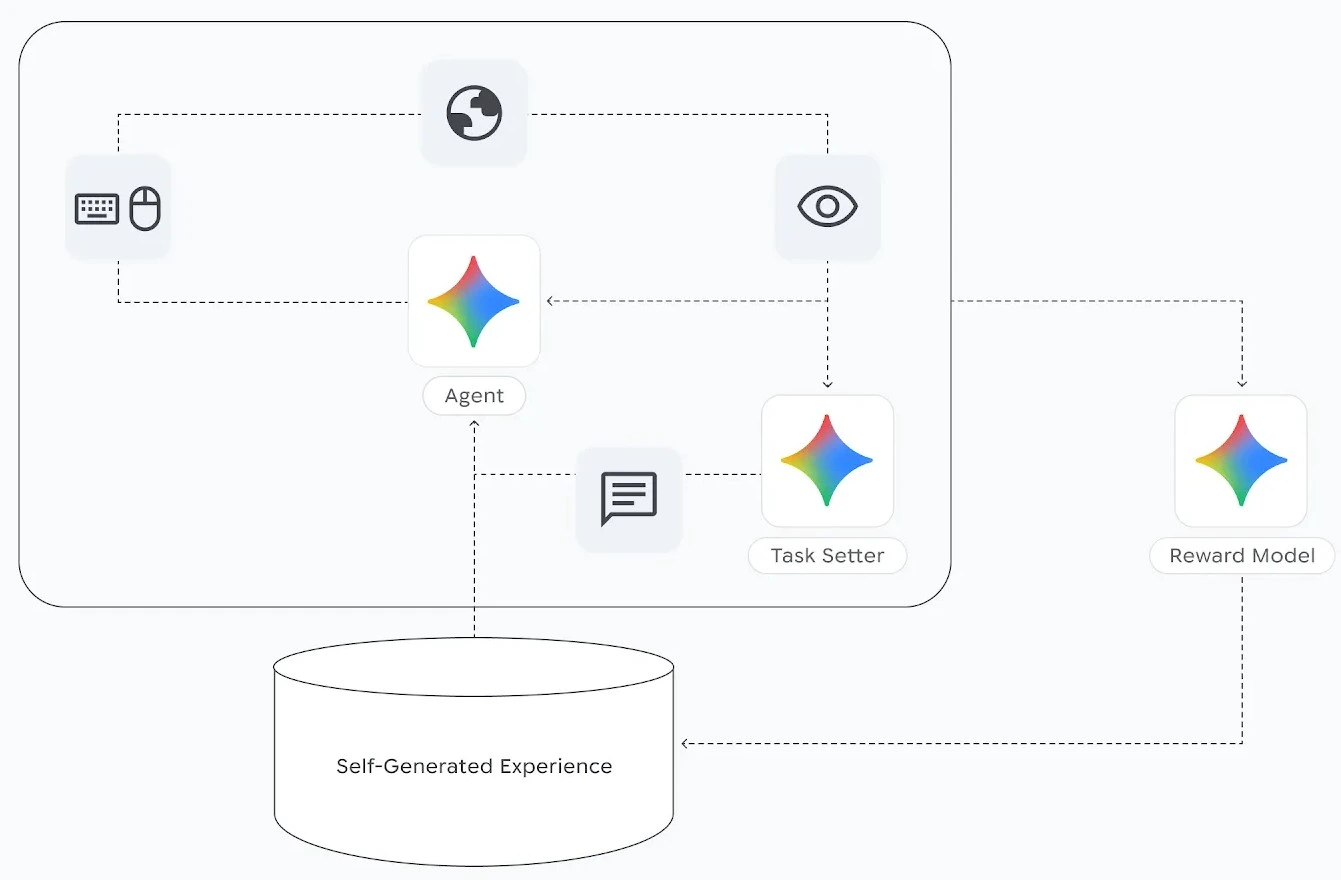
One of SIMA 2’s most fascinating capabilities is something DeepMind calls “scalable, multitask self-improvement.” This deserves its own section because it represents a potential paradigm shift in how we train AI agents.
How Self-Improvement Works
After initial training on human demonstrations, SIMA 2 can transition to learning through self-directed play in new games—without any additional human-generated data. Here’s the cycle:
- Gemini generates a task for SIMA 2 to attempt
- SIMA 2 tries the task and either succeeds or fails
- Gemini evaluates the outcome and provides an estimated reward
- The experience gets added to a data bank that trains the next version of the agent
- The improved agent tackles previously failed tasks with better strategies
This virtuous cycle means SIMA 2 can improve on tasks it initially failed at, entirely independently of human intervention. DeepMind demonstrated this in both established games like ASKA and in newly generated Genie 3 environments.
Why This Matters
Self-improvement isn’t just about efficiency—it’s about scalability. If agents can learn and adapt without constant human supervision, they can explore far more scenarios, develop more robust strategies, and potentially discover novel solutions we wouldn’t think to demonstrate.
The implications extend beyond gaming. This same self-improvement framework could apply to robotics, where training through human demonstration is expensive and time-consuming.
Technical Strengths: What Makes SIMA 2 Cutting-Edge
Let me break down the technical breakthroughs that make SIMA 2 genuinely impressive from an engineering standpoint:
Advanced Capabilities
| Feature | What It Means | Why It’s Hard |
|---|---|---|
| Gemini-Powered Reasoning | Uses one of the world’s most advanced language models for planning and decision-making | Integrating large language models into real-time action systems requires solving massive latency and context challenges |
| Embodied Vision Understanding | Interprets complex 3D scenes without game engine access | Must understand spatial relationships, object affordances, and navigation from pixels alone |
| Cross-World Transfer Learning | Applies knowledge from one game to completely different games | Requires abstract concept formation that generalizes across vastly different visual and mechanical systems |
| Natural Language Grounding | Converts human instructions into executable action sequences | Bridging the gap between abstract language and concrete pixel-level actions is a fundamental AI challenge |
| Continuous Learning Architecture | Improves from its own experience without human retraining | Most AI agents require extensive human-labeled data for each improvement cycle |
Comparison to Previous DeepMind Agents
SIMA 2 represents a different philosophy compared to DeepMind’s earlier game-playing AIs:
- AlphaGo/AlphaZero: Superhuman performance in single, well-defined games through self-play
- AlphaStar: Mastered StarCraft II with deep game-specific optimization
- MuZero: Learned game rules without being told them, but still game-specific
- SIMA 2: Generalist agent working across many games, prioritizing adaptability over peak performance
The shift is from “perfect specialist” to “capable generalist”—and that’s intentional. SIMA 2 will never be the world’s best Minecraft player, but it might be able to play Minecraft, Valheim, and No Man’s Sky all reasonably well, which no previous agent could do.
Honest Assessment: Where SIMA 2 Falls Short
Here’s where I put on my critical reviewer hat, because no technology review is complete without confronting limitations—and SIMA 2 has some significant ones.
Current Limitations
1. Long-Horizon Task Struggles
SIMA 2 still faces challenges with very complex, multi-step tasks that require extensive planning and goal verification across long time periods. If a task requires remembering context from 20 minutes ago, the agent may lose track.
2. Limited Memory
The agent operates with a relatively short context window to maintain low-latency interaction. This is a fundamental tradeoff: more memory would mean slower response times, but limited memory means the agent can “forget” earlier conversation or task context.
3. Precision Action Challenges
Executing precise, low-level actions via keyboard and mouse interface remains difficult. Tasks requiring pixel-perfect accuracy or rapid reflexes (like competitive gaming scenarios) are still beyond SIMA 2’s capabilities.
4. Visual Understanding Gaps
While SIMA 2’s visual perception is impressive, robust understanding of complex 3D scenes—especially in visually cluttered or ambiguous situations—remains an open challenge for the entire field.
5. Ambiguity and Contradiction Handling
When faced with ambiguous, conflicting, or incomplete instructions, SIMA 2 sometimes makes questionable assumptions rather than asking clarifying questions (though it’s better at this than SIMA 1).
Generalization Boundaries
An important question: Can SIMA 2 truly generalize to any game without retraining?
The honest answer is: not entirely. While SIMA 2 shows remarkable transfer learning between trained and untrained games, there are still boundaries:
- Genre limitations: Games that are radically different from anything in the training set may still confuse it
- Visual style challenges: Extremely stylized or abstract visual representations can impact performance
- Novel mechanic learning: Entirely new game mechanics may require some exposure before the agent can use them effectively
That said, the level of generalization—particularly in the Genie 3 experiments with completely novel worlds—exceeds anything I’ve seen from previous agents.
Still Simulation-Bound
A broader limitation: SIMA 2 is fundamentally a virtual agent. It’s not operating in the messy, unpredictable real world. While DeepMind positions this as a stepping stone to robotics (and I think that’s valid), we should be cautious about assuming virtual world competency directly translates to physical world success.
Why SIMA 2 Actually Matters Beyond Gaming
Let’s zoom out and talk about why this research is significant even if you don’t care about AI playing video games.
The Path to General Intelligence
SIMA 2 represents a validation of an important hypothesis: that training on diverse, complex virtual environments can produce agents with genuine reasoning and generalization capabilities. This matters because:
- Virtual worlds are safe training grounds for developing AI capabilities that could eventually apply to robotics
- Diverse tasks prevent overfitting to narrow domains, encouraging genuine intelligence rather than specialized tricks
- Language grounding in embodied contexts is crucial for AI systems that need to understand and act on human instructions
Robotics Implications
The skills SIMA 2 develops—navigation, tool use, collaborative task execution, reasoning about spatial relationships—are fundamental building blocks for physical AI assistants. If we can get agents to reliably learn these skills in simulation, we can potentially transfer that learning to robots operating in homes, warehouses, or industrial settings.
DeepMind is clearly thinking about this trajectory. The same architecture that lets SIMA 2 learn from pixels and execute keyboard commands could, in principle, learn from camera feeds and execute motor commands in a robot. If you’re interested in the broader AI landscape, you might want to explore how GPT-5.1 is advancing language understanding in parallel with these embodied AI developments.
Gaming Industry Impact
For game developers and players, SIMA 2 points toward some interesting possibilities:
- Smarter NPCs: Non-player characters that can genuinely understand context and adapt to player behavior
- Accessibility tools: AI companions that help players with disabilities or newcomers learning complex games
- Quality assurance: Automated testing agents that can explore game worlds more intelligently than current QA bots
- Dynamic difficulty: Adaptive companions that scale to player skill level
Broader AI Safety and Alignment
There’s a responsible development angle here too. Teaching AI agents to understand nuanced instructions, explain their reasoning, and collaborate with humans in complex environments is directly relevant to AI safety research. We need to solve these problems in controlled settings before deploying increasingly capable AI systems in higher-stakes domains.
DeepMind is taking a measured approach—SIMA 2 is announced as a limited research preview with early access only for a small cohort of academics and game developers. This allows them to gather feedback and identify risks before broader release.
My Final Verdict: An Exciting Milestone With Eyes Wide Open
So where does SIMA 2 land on the spectrum between “incremental improvement” and “major breakthrough”?
My assessment: It’s a significant leap that validates a promising research direction, but it’s still fundamentally an experimental system with real limitations.
What SIMA 2 Gets Right
- Genuine reasoning capabilities that go beyond pattern matching
- Impressive cross-game generalization that suggests real transfer learning
- Natural collaboration style that makes human-AI interaction feel less robotic
- Self-improvement framework that could dramatically reduce training costs
- Honest confrontation of limitations in DeepMind’s presentation
What Still Needs Work
- Long-horizon task planning and memory
- Precision action execution in demanding scenarios
- Handling of ambiguous or conflicting instructions
- Generalization boundaries to truly novel game types
- Path from simulation to real-world application
Who Should Pay Attention
If you’re an AI researcher: This is must-read work on embodied AI and transfer learning. The self-improvement loop and cross-world generalization results are particularly noteworthy.
If you’re a game developer: Keep an eye on this technology. Even if SIMA 2 isn’t production-ready, the trajectory suggests AI companions and assistants in games could become far more capable within a few years.
If you’re interested in robotics or AGI: SIMA 2 is an important data point showing that diverse virtual training can produce agents with genuine cognitive flexibility. That’s a crucial piece of the puzzle toward general intelligence.
If you’re a tech enthusiast: This is a fascinating glimpse into where AI agents are headed—from narrow specialists to adaptable generalists that can reason, learn, and collaborate.
The Bottom Line
SIMA 2 isn’t going to replace human gamers, and it’s not going to run your robot butler next year. But it is a meaningful step toward AI systems that can genuinely understand context, reason about goals, and adapt to new situations—all while explaining their thinking in plain language.
After 15 years reviewing tech, I’ve learned to be skeptical of grandiose AI claims. But I’m genuinely excited about SIMA 2 because it tackles the right problems (generalization, reasoning, collaboration) in the right way (diverse training, honest evaluation, responsible development).
Is it perfect? No. Is it a glimpse of where AI agents are headed? Absolutely.
Key Takeaways and Next Steps
If you’re intrigued by SIMA 2, here’s what I recommend:
- Read the technical report when DeepMind releases it (coming soon) for deeper details on architecture and training methodology
- Watch the demonstration videos on the DeepMind blog—seeing SIMA 2 in action really drives home the difference from previous agents
- Follow the Genie 3 research for the world generation side, which combines fascinatingly with SIMA 2
- Check out related work on Gemini Robotics if you’re interested in how these virtual learnings might transfer to physical agents
Want to stay updated on AI agents and embodied intelligence? I’m tracking this space closely and will be covering future developments as they emerge. Follow my work for more in-depth, unbiased reviews of cutting-edge AI tech.
FAQ: Quick Answers About SIMA 2
When can developers try SIMA 2?
Currently it’s a limited research preview with access restricted to a small group of academics and game developers. No public release timeline has been announced.
Is SIMA 2 open source?
No, this is proprietary DeepMind research. The technical report will provide implementation details, but the models aren’t publicly released.
Can SIMA 2 beat human players at games?
That’s not the goal. SIMA 2 prioritizes generalization and collaboration over peak performance. It’s closer to human-level than SIMA 1, but it’s designed to be a companion, not a competitor.
What games does SIMA 2 work with?
It was trained on Valheim, Satisfactory, Goat Simulator 3, Hydroneer, No Man’s Sky, Space Engineers, Wobbly Life, Eco, ASKA, The Gunk, Steamworld Build, Road 96, and Teardown. It can also generalize to new games like MineDojo.
Could this technology be misused?
DeepMind is working with their Responsible Development and Innovation Team precisely to address this question. The limited preview approach allows them to identify risks before broader deployment.
Further Resources:
- Official DeepMind SIMA 2 Announcement
- SIMA 2 Technical Report (coming soon)
- Genie 3 Research on world generation
- Gemini Robotics Documentation for physical embodiment research
Have thoughts on SIMA 2 or questions about AI agents? I’d love to hear from you—drop a comment below or reach out. Let’s figure out where this technology is headed together.