
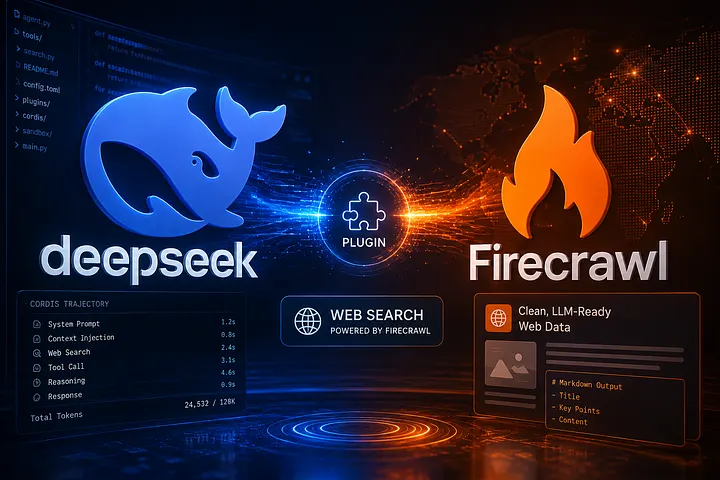
DeepSeek’s plug-in-everything coding harness is turning heads, but out of the box it can’t reliably search the web. Here’s the gap, the fix, and why it matters for anyone running AI agents.
What DeepSeek Actually Shipped
DeepSeek’s last major moment was R1 in January 2025, a reasoning model trained through self-taught reinforcement learning that cut training costs dramatically and got copied across the industry within months. The new harness is trying to repeat that trick, this time on the agent tooling side rather than the model side.
The core idea is Cordis: a plugin system where tools, sandboxing, and the agent loop are all modular. Static presets load at session start, but a separate class of dynamic plugins can be created, toggled, and removed mid-session without restarting anything. In one demo, a user asked the harness to change its own interface theme, watched it generate a plugin to do exactly that, and then toggled it on and off live.
Full trajectory visibility
The team has also gone deep on observability. A full trajectory view exposes the system prompt, every context injection, each tool call, reasoning time, and time to first token for a session. Anyone who has tried to debug why an agent picked the wrong tool at 2 a.m. will recognize how rare that level of transparency is in most harnesses, which tend to hide this by default.
The Web Search Wall Nobody Talks About
Here’s where the architecture runs into a wall. By default, web search inside the harness requires a DeepSeek API key. No key, no search, and the agent throws an error the moment it needs to look something up. For a tool built around the idea that everything is swappable, needing to route every search through one company’s infrastructure is an odd bottleneck to leave in place.
AI web scraping is the missing layer. An agent that reasons well but can’t dependably pull real content off a live page is only doing half its job. It can plan a task correctly and still fail at the very last step because the page it needed came back as raw JavaScript instead of usable text.
DeepSeek’s own plugin ecosystem already has an answer: install a small package, expose a generic web search tool in a config file, restart the session, and the harness routes its searches through a different provider entirely. The plugin most people are reaching for to do this is Firecrawl.
Why the Fix Is Firecrawl and Not Just “A Scraper”
It’s tempting to think any scraping library would slot into that gap the same way. Watch the trajectory logs of an actual search and the difference becomes obvious fast.
Clean markdown instead of raw HTML
Most raw scraping tools hand an agent a pile of raw HTML, cookie banners, navigation menus, and ad markup included. The model then has to spend tokens and reasoning steps figuring out what part of the page is actually useful. Firecrawl instead returns clean, LLM-ready markdown, stripped down to the content that matters. On one page that’s a small win. Across a long agent session running dozens of searches, it’s the difference between an agent that stays on task and one that slowly drowns in irrelevant context.
It works across harnesses, not just DeepSeek’s
The same Firecrawl setup that plugs into DeepSeek’s new harness works identically inside Claude Code, Open Code, or whichever framework launches next. That portability is worth more than it sounds, because nobody actually knows which of these harnesses will still matter in a year. Betting your workflow on the framework is a gamble. Betting on the data layer underneath it is not.
If you’ve searched around for firecrawl alternatives before, it’s worth knowing what you’re actually comparing. Crawl4AI is a solid pick if you want something fully open source and self-hosted. Browser-use style agents are the better call for tasks that need real clicking and form-filling rather than clean content extraction. But for the specific job of handing an AI agent readable, structured web data without babysitting proxies or headless browsers, Firecrawl is the tool most of these harnesses keep converging on.
How to Add This to Your Own Agent Stack
You don’t need DeepSeek’s harness specifically to hit this problem. Any coding agent that needs live web data runs into the same wall eventually. The general pattern looks like this:
- Install the web scraping provider as a plugin or tool integration for whatever harness or framework you’re running.
- Expose a generic search or scrape tool in the config, since most harnesses ship this disabled by default.
- Restart the session if your harness uses static plugin presets (dynamic plugin systems like Cordis skip this step).
- Point every “read this page” or “search the web” tool call at the new provider instead of the built-in one.
The setup takes a few minutes. What you get back is an agent that doesn’t choke on JavaScript-heavy pages or die the moment it needs information the model wasn’t trained on.
Try Firecrawl Free →One Catch Worth Knowing
DeepSeek’s plugin system has a real trust gap that’s worth flagging before anyone gets too excited about the “everything is a plugin” pitch. Plugins aren’t sandboxed. Whatever you install gets full shell access and full access to your file system, and because plugins are distributed through GitHub, that opens the door to installing something that quietly goes hunting for API keys.
Full shell access, no sandbox. A harness whose entire job is supposed to be resisting prompt injection shouldn’t make it this easy to hand out unrestricted access. It’s still a developer preview, so there’s time to fix it.
In the meantime, routing web access through an established, audited API instead of a random community-built scraper isn’t just about cleaner output. It’s about not handing a stranger’s code root access to your machine because you wanted better search results.
Key Takeaways
- DeepSeek’s new harness earned 150K+ GitHub stars in days on the strength of Cordis, a fully modular plugin architecture.
- Web search is locked behind a DeepSeek API key by default, a real gap for a tool built around flexibility.
- The community’s fix is a Firecrawl plugin that returns clean, LLM-ready markdown instead of raw HTML.
- Firecrawl’s setup isn’t harness-specific, the same integration works across Claude Code, Open Code, and DeepSeek’s new tool.
- Unsandboxed plugins with full shell access are a real risk, choose a vetted web data provider over random GitHub plugins.
The Bottom Line
Coding harnesses are turning into a commodity layer fast. Cordis is a genuinely clever idea, and there’s a good chance another framework borrows the concept the same way the industry borrowed DeepSeek’s training techniques after R1. But the actual bottleneck was never which harness you’re running. It’s whether the agent can get clean, accurate information from the live web when it needs it.
That’s the gap Firecrawl fills, and it’s why the same fix keeps showing up across completely different frameworks. If you’re setting up an agent stack and want AI web scraping that doesn’t choke your context window with junk HTML, Firecrawl is the tool to start with. It includes 1,000 free credits a month with no card required, enough to test whether it solves the same problem in your setup that it solved here.
Try Firecrawl Free →