Google’s Gemini Deep Research Review 2025
Google’s reimagined Gemini Deep Research agent represents a fundamental shift in AI-powered research capabilities. Released on December 11, 2025, through the new Interactions API, this autonomous research agent can conduct multi-step investigations with thoroughness that previously required entire analyst teams. Unlike standard chatbots, it iteratively plans investigations, formulates queries, identifies knowledge gaps, and searches again until achieving comprehensive topic understanding.
What Is Gemini Deep Research
Gemini Deep Research is an AI agent specifically designed for long-running research and information synthesis tasks. The agent uses Gemini 3 Pro as its reasoning engine—Google’s most factual model to date, trained to minimize hallucinations and maximize report quality during complex tasks. Google has opened this capability to developers through the Interactions API, allowing direct embedding of Google’s most advanced autonomous research capabilities into custom applications.
What distinguishes this tool is its iterative research approach. The agent plans investigations, formulates search queries, reads results, identifies missing information, and searches again until achieving comprehensive understanding. This release features vastly improved web search capabilities, allowing navigation deep into websites to extract specific data points that typically challenge standard AI systems.
Technical Foundation
Multi-Step Reinforcement Learning
The agent employs scaled multi-step reinforcement learning specifically optimized for search tasks. This training approach enables the system to navigate complex information landscapes with high accuracy, learning optimal research strategies through experience rather than simply matching keywords.
Benchmark Performance
Google released impressive performance metrics alongside this launch. The agent achieves 46.4% on Humanity’s Last Exam (HLE)—a state-of-the-art result on questions designed to test the absolute frontier of AI knowledge. It also scores 66.1% on DeepSearchQA, Google’s new benchmark for research agents, and 59.2% on BrowseComp, OpenAI’s browsing benchmark.
| Benchmark | Score | Significance |
|---|---|---|
| Humanity’s Last Exam | 46.4% | State-of-the-art on frontier AI knowledge testing |
| DeepSearchQA | 66.1% | Multi-step research comprehensiveness |
| BrowseComp | 59.2% | Web browsing and information extraction |
DeepSearchQA: New Research Standard
Google open-sourced a new benchmark called DeepSearchQA, featuring 900 hand-crafted “causal chain” tasks across 17 different fields. Each research step depends on correctly completing previous ones, mirroring how actual research unfolds. Unlike traditional benchmarks testing simple fact retrieval, DeepSearchQA measures comprehensiveness by requiring agents to generate exhaustive answer sets.
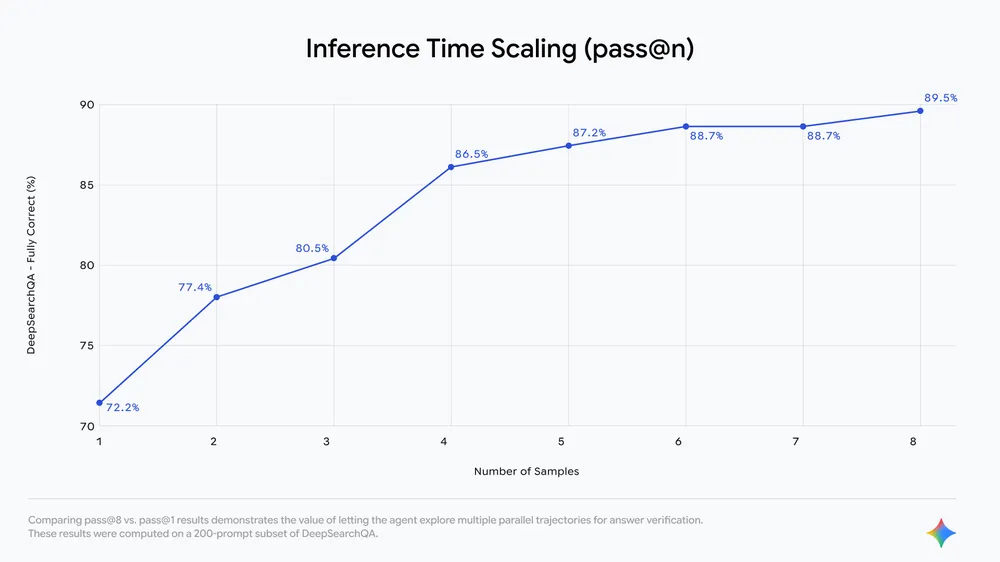
The benchmark includes performance metrics for “thinking time”—measuring what happens when agents conduct more searches and perform additional reasoning steps. Internal evaluations showed significant performance gains with this approach, suggesting future versions could demonstrate even greater capabilities. Comparing pass@8 versus pass@1 results demonstrates substantial value in allowing agents to explore multiple parallel trajectories for answer verification.
Real-World Applications
Financial Due Diligence
Financial firms are using Deep Research to automate initial due diligence stages. The agent aggregates market signals, competitor analysis, and compliance risks from across web and proprietary sources. According to KJ Sidberry, Partner at GV (Google Ventures), the tool shortened research cycles from days to hours without quality loss.
Biotech and Drug Discovery
Axiom Bio, which develops AI systems predicting drug toxicity, found that Deep Research unlocked unprecedented depth across biomedical literature. Co-founder Alex Beatson noted it surfaces granular data at levels previously achievable only by human researchers. This capability could genuinely accelerate drug discovery timelines by synthesizing information across thousands of research papers, clinical trials, and molecular databases.

Market Research
Market research represents another strong application area. Analyzing competitor strategies, identifying market trends, and synthesizing consumer sentiment across multiple sources align perfectly with Deep Research’s capabilities for comprehensive information gathering and synthesis.
Key Developer Features
For developers building AI-powered applications, Deep Research offers several critical capabilities through the Interactions API:
- Unified Information Synthesis: The agent analyzes your documents (PDFs, CSVs, Google Docs) alongside public web data using File Upload and File Search Tool. This enables context from proprietary data sources while conducting broader research.
- Report Steerability: Control output through prompting by defining report structure, specifying headers and subheaders, requesting specific data tables, and controlling formatting. This level of control proves essential for production applications requiring consistent, structured outputs.
- Detailed Citations: Every claim includes granular sourcing, allowing users to verify information origins. For applications where accuracy matters, citation tracking is non-negotiable.
- Structured Outputs: The agent supports JSON schema outputs, simplifying programmatic parsing of research results. This becomes essential for applications needing to act on research findings automatically.
Ready to Build with Deep Research?
Get your Gemini API key and start integrating Google’s most advanced autonomous research capabilities into your applications today.
Access Developer DocumentationAccessing Deep Research
Getting started requires a Gemini API key from Google AI Studio, then accessing Deep Research through the new Interactions API. The Interactions API represents Google’s next-generation interface for working with Gemini models and agents, designed to simplify embedding AI capabilities into applications. Deep Research is the flagship use case demonstrating this new interface.
Google mentions the service is “optimized to generate well-researched reports at much lower cost” but doesn’t provide specific pricing details in the announcement. Developers planning production deployments should check current API pricing pages for exact costs. The tool is now available to Gemini Advanced users in over 45 languages and more than 150 countries.
What’s Coming Next
Google outlined several planned improvements for Deep Research:
- Native Chart Generation: Future versions will generate charts and visual analytical reports directly, eliminating the workflow bottleneck of manually creating visualizations from research data.
- Model Context Protocol (MCP) Support: Expanded MCP connectivity will simplify custom data source integration, critical for enterprise applications requiring proprietary data integration.
- Vertex AI for Enterprises: Google is bringing Deep Research to Vertex AI, their enterprise cloud platform, providing security, compliance, and infrastructure features large organizations require.
- Product Integration: Deep Research will integrate into Google Search (as “Deep Search”), NotebookLM, Google Finance, and the Gemini App. This suggests Google views this as core capability across their product ecosystem.
Critical Assessment
Comparison to Other Tools
What distinguishes Deep Research is the depth of Google’s integration with their search infrastructure and specific optimization for long-running, multi-step research tasks. The benchmark performance suggests this is genuinely best-in-class for complex research, though real-world performance varies based on specific use cases. For those seeking similar capabilities in project management contexts, tools like Pipedrive offer different approaches to information organization and workflow optimization.
Handling Hallucinations
Google emphasizes that Gemini 3 Pro is their “most factual model yet,” specifically trained to reduce hallucinations. The detailed citation tracking helps verify claims. However, no AI model achieves perfection, and users should always verify critical information, especially for high-stakes decisions.
Strengths
- State-of-the-art benchmark performance on complex research tasks
- Iterative investigation approach with knowledge gap identification
- Comprehensive citation tracking for verification
- Developer API access for custom integrations
- Proven results in financial and biotech applications
Limitations
- 46.4% HLE score indicates room for improvement
- Requires “thinking time” rather than instant responses
- Pricing details not fully transparent in initial release
- Still requires human judgment and verification
- API access requires technical expertise for integration
Practical Usefulness
The API access targets developers, but integration into the Gemini App and other Google products will make this accessible to regular users. For individuals who frequently conduct research for work, writing, or personal projects, having an agent capable of spending hours gathering and synthesizing information could prove genuinely valuable.
Who Should Use This
Deep Research makes the most sense for several specific audiences:
- Developers Building Research Tools: For applications needing comprehensive research capabilities, the API access is transformative.
- Financial Analysts: The due diligence use case proves compelling, especially for preliminary research phases.
- Research Teams: Academic researchers, market analysts, and anyone conducting regular literature reviews could benefit significantly.
- Content Creators: Writers, journalists, and content marketers researching complex topics thoroughly.
- Business Intelligence Professionals: Those responsible for competitor analysis, market research, or strategic planning.
Important Consideration: Deep Research is a tool, not a replacement for human judgment. The citations and structured outputs make it auditable and verifiable, which represents exactly the right approach. Use it to accelerate and enhance research, but always apply critical thinking to results.
Bottom Line
Google’s Gemini Deep Research represents genuine advancement in AI-powered research tools. The combination of iterative investigation, deep web navigation, and comprehensive synthesis creates something qualitatively different from standard AI assistants. Real-world testimonials from financial firms and biotech companies suggest this delivers practical value in demanding professional contexts beyond just impressive benchmarks.
For developers, the API access opens interesting possibilities for building AI-powered applications with genuine research depth. For end users, upcoming integration into Google’s consumer products will make this accessible without technical expertise. The open-sourcing of DeepSearchQA also provides the AI research community a better way to measure and improve research agent capabilities, which should accelerate progress across the field.
If your work involves significant research—whether financial analysis, academic investigation, market research, or content creation—this tool merits exploration. The ability to offload hours of preliminary research to an AI agent while maintaining verification and validation capabilities could fundamentally change how research-intensive work gets done.
Start Your Deep Research Journey
Visit Google AI Studio to get your API key and start building with Gemini Deep Research, or wait for integration into consumer products for a ready-made solution.
Get Started Now