Gemini 3 Pro Destroys GPT-5: Shocking Benchmark Data
The AI race just hit a turning point, and if you’re still treating these tools like glorified chatbots, you’re missing the revolution happening right now. Gemini 3 Pro is the first AI model that feels like it’s operating on a fundamentally different level—dominating industry benchmarks, processing information with a context window larger than most novels, and demonstrating reasoning capabilities that are frankly unsettling in how advanced they are.
Whether you’re writing code, conducting research, creating content, or running a business, Gemini 3 Pro introduces capabilities that weren’t possible six months ago. The data doesn’t lie—and the performance charts prove it.
What Makes Gemini 3 Pro Different?
Gemini 3 Pro is Google DeepMind’s flagship AI model for 2025, built from the ground up as a unified, multimodal intelligence system. Unlike competitors that essentially glue together separate models for text, vision, and audio, Gemini 3 Pro was architected as a single cohesive system that natively understands and processes multiple data types simultaneously.
The evolution tells the story: Gemini 1.0 introduced multimodal capabilities. Gemini 2.5 Pro expanded context and reasoning. Gemini 3 Pro takes everything to production-grade reliability with performance that sets new industry standards. Learn more about the official Gemini Pro specifications from Google DeepMind.
Core specifications that matter:
- 1,000,000-token context window (process entire books at once)
- Native multimodal processing (text, images, video, audio, code)
- Deep Think Mode for complex reasoning tasks
- Agentic coding capabilities with terminal operation
- Enterprise-grade security and compliance
But specs only tell part of the story. What really matters is performance—and that’s where Gemini 3 Pro separates itself from the pack.
The Benchmark Results That Actually Matter
Numbers don’t lie, and the benchmark data reveals a clear story about Gemini 3 Pro’s capabilities across critical performance dimensions.
Agentic Coding Performance
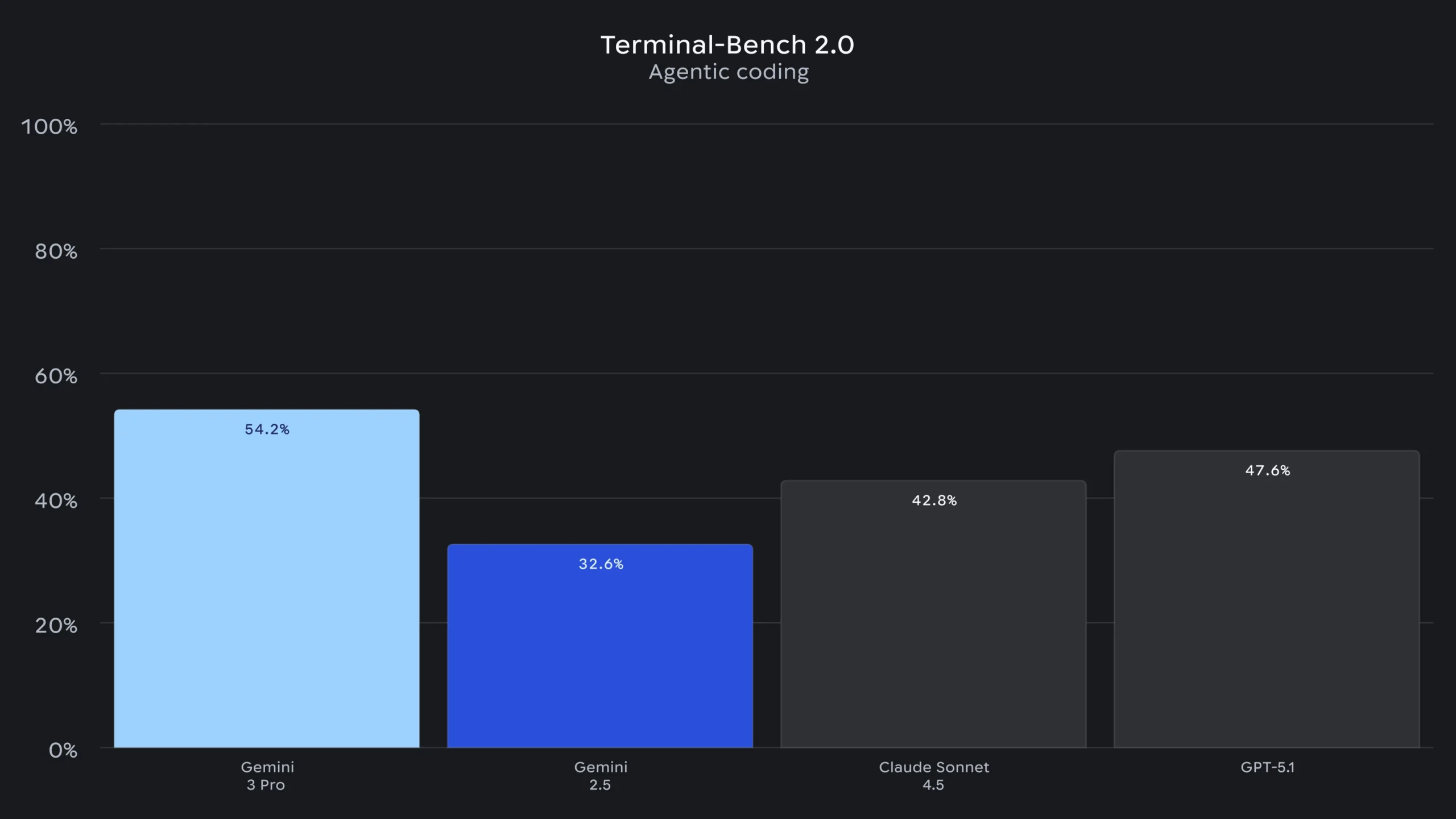
Terminal-Bench 2.0 tests how well AI models can actually operate as coding agents—writing code, debugging, and executing terminal commands autonomously.
The results:
- Gemini 3 Pro: 54.2% – Crushing the competition
- Gemini 2.5: 32.6%
- Claude Sonnet 4.5: 42.8%
- GPT-5.1: 47.6%
That 54.2% isn’t just a marginal improvement—it’s a 66% increase over Gemini 2.5 and represents the highest score in the benchmark. This translates directly to real-world capability: Gemini 3 Pro can handle more complex coding tasks with less human intervention. The difference between 32% and 54% is the difference between a code assistant and an actual coding partner.
Advanced Reasoning
Three critical benchmarks reveal where Gemini 3 Pro really flexes its capabilities.
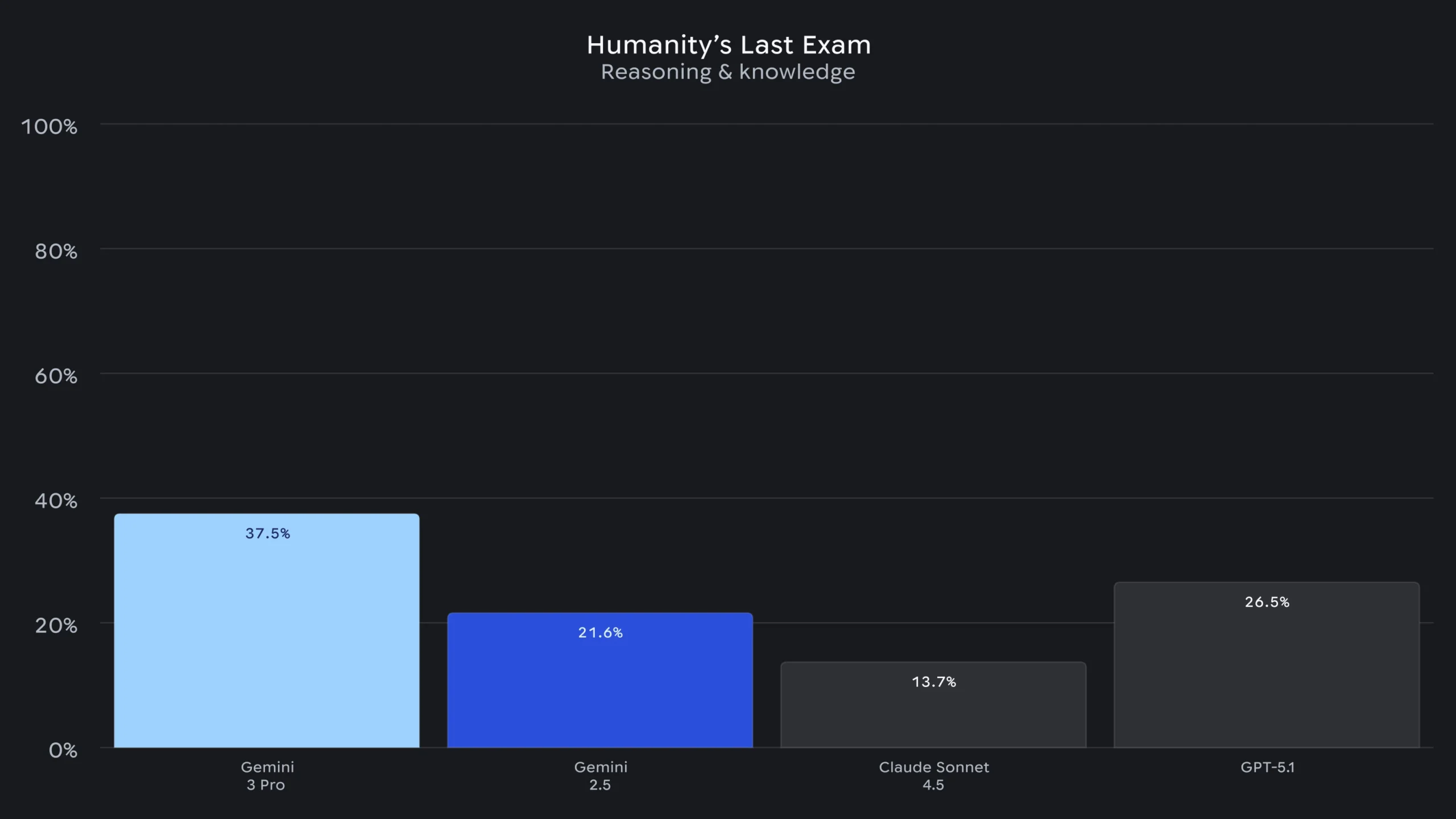
Humanity’s Last Exam (Reasoning & Knowledge): This benchmark tests comprehensive reasoning across multiple domains—the kind of thinking required for complex problem-solving. Gemini 3 Pro achieves 37.5%, compared to Gemini 2.5’s 21.6%, Claude Sonnet 4.5’s 13.7%, and GPT-5.1’s 26.5%. When Gemini 3 Deep Think is enabled, performance jumps to 41%.
GPQA Diamond (Scientific Knowledge): PhD-level science questions that require deep domain expertise. Gemini 3 Pro reaches 91.9% accuracy, surpassing Gemini 2.5 Pro (86.4%), Claude Sonnet 4.5 (83.4%), and GPT-5.1 (88.1%). Over 90% accuracy on questions that would stump most humans with graduate degrees demonstrates genuine understanding of complex scientific concepts.
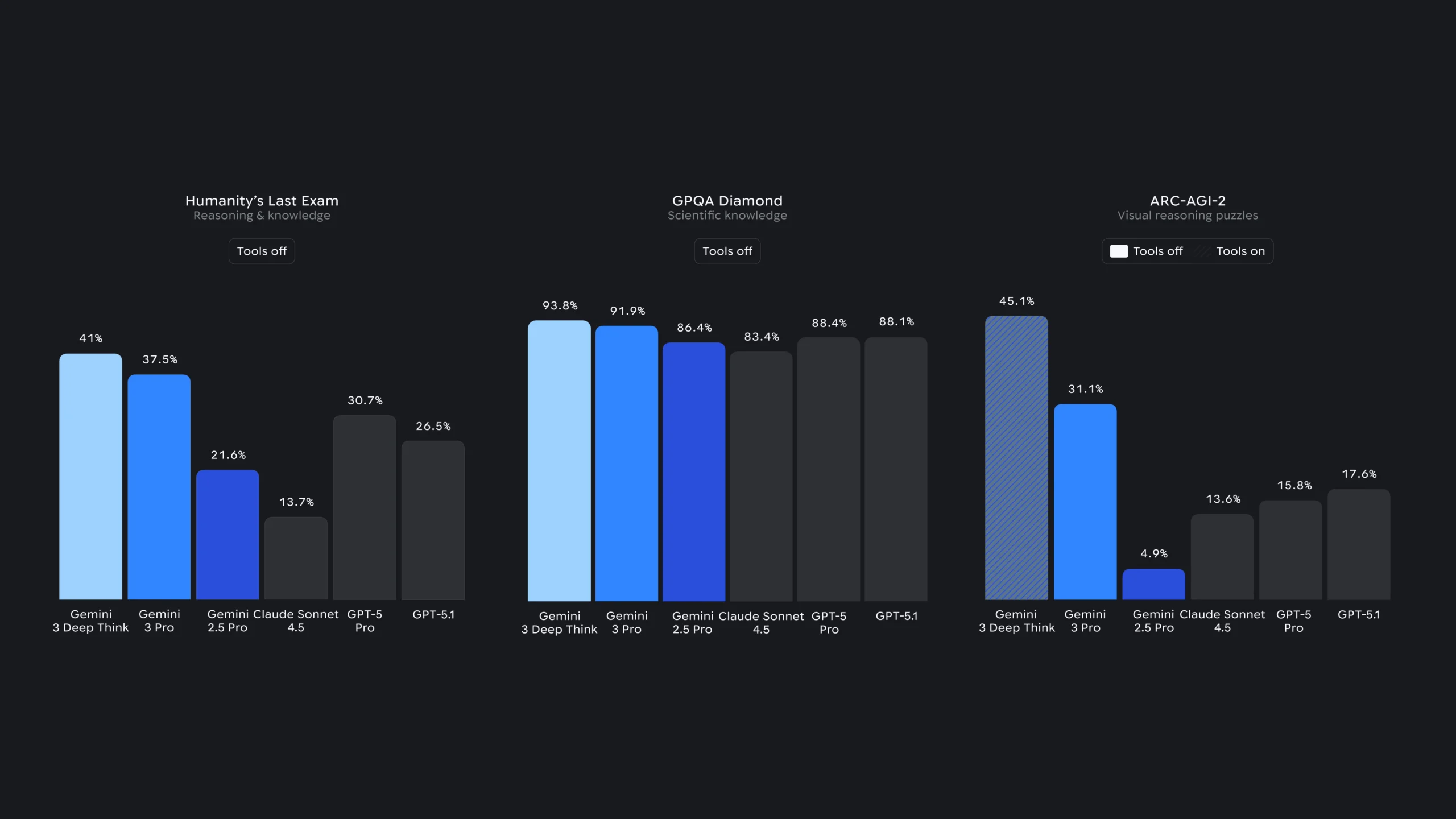
ARC-AGI-2 (Visual Reasoning Puzzles): The ARC-AGI benchmark specifically tests general intelligence through pattern recognition and abstract reasoning—capabilities that can’t be gamed through training data. Gemini 3 Deep Think achieves 45.1% (with tools enabled), while Gemini 3 Pro reaches 31.1%, Gemini 2.5 Pro only 4.9%, Claude Sonnet 4.5 13.6%, and GPT-5.1 17.6%. That jump from 4.9% to 31.1% represents a 534% improvement between Gemini 2.5 and 3 Pro.
Consolidated Performance
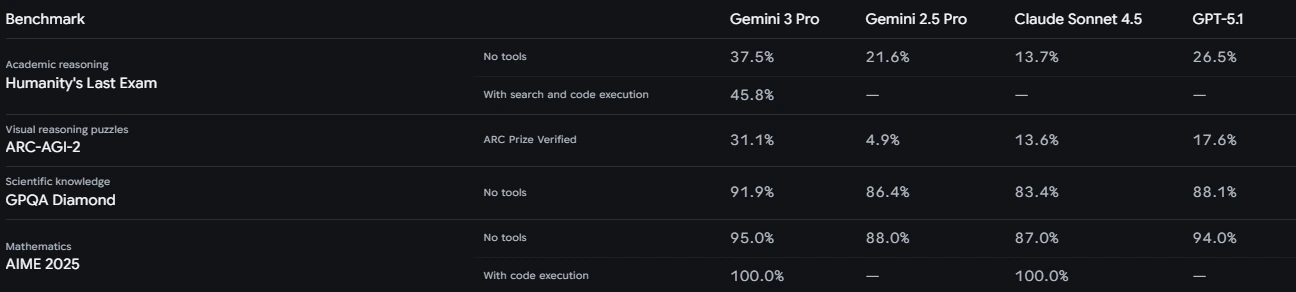
| Benchmark | Gemini 3 Pro | With Enhancements | Capability Tested |
|---|---|---|---|
| Humanity’s Last Exam | 37.5% | 45.8% (search + code) | Multi-domain reasoning |
| ARC-AGI-2 | 31.1% | 45.1% (Deep Think) | Abstract visual reasoning |
| GPQA Diamond | 91.9% | — | PhD-level science |
| AIME 2025 | 95.0% | 100.0% (code execution) | Advanced mathematics |
| Terminal-Bench 2.0 | 54.2% | — | Agentic coding |
That mathematics performance is particularly striking. International Mathematics Olympiad problems that typically stump human competitors? Gemini 3 Pro achieves 95% accuracy, and perfect accuracy when allowed to verify solutions through code execution.
The Million-Token Context Window: Why Size Actually Matters
Most people gloss over context window specs because they sound technical. Don’t make that mistake—this is one of the most transformative capabilities in Gemini 3 Pro.
A context window determines how much information an AI can actively work with in a single conversation. Most AI models tap out around 8,000-32,000 tokens (roughly 6,000-24,000 words). Gemini 3 Pro’s 1,000,000-token context window can process entire books, research corpora, or massive codebases simultaneously.
Real capacity:
- Complete novel: approximately 100,000 words = 130,000 tokens
- PhD dissertation: approximately 100,000 words = 130,000 tokens
- Your entire company’s documentation: often under 500,000 tokens
- Large codebase: depends on size, but many fit comfortably
This isn’t just “more is better.” It’s qualitatively different. When an AI can hold your entire project in working memory, it stops being a tool you consult and becomes a system that genuinely understands your work. Uploading a complete content library or entire codebase allows for contradiction identification, architectural analysis, and holistic optimization that would take weeks of manual review.
Multimodal Intelligence: Beyond Text Chatbots
True multimodality means the AI doesn’t just accept different file types—it understands the relationships between text, visual information, audio cues, and code structure as a unified whole.
Practical applications tested:
- Content research: Upload competitor YouTube videos, transcribe and analyze them alongside written articles, then identify unique angles and gaps in coverage
- Technical documentation: Photograph whiteboard diagrams from planning sessions, upload meeting recordings, and share existing technical docs for integrated architecture documentation
- Code debugging: Submit screenshots of error messages plus relevant code files plus terminal output for comprehensive diagnosis in one shot
The AI doesn’t just summarize each piece separately—it synthesizes across formats to find insights no single data type would reveal.
Deep Think Mode: When Speed Isn’t the Priority
Most AI interactions optimize for fast responses. Deep Think Mode does the opposite—it takes more time to reason through problems methodically, exploring multiple solution pathways before committing to an answer.
When to use Deep Think:
- Strategic business planning with competing priorities
- Complex mathematical or logical problems
- Research synthesis across multiple domains
- Architectural decisions with long-term implications
- Any scenario where being right matters more than being fast
When not to use it:
- Quick factual lookups
- Simple content generation
- Routine tasks
- Time-sensitive operations
The performance data backs this up. On Humanity’s Last Exam, standard Gemini 3 Pro scores 37.5%. With Deep Think enabled, that jumps to 41%. On ARC-AGI-2, the improvement is even more dramatic: from 31.1% to 45.1%.
Agentic Coding: From Assistant to Partner
The term “agentic coding” gets thrown around a lot. Here’s what it actually means with Gemini 3 Pro: you describe an outcome, and the AI architects, implements, tests, and operates systems autonomously.
Real projects built:
- Automated data pipeline: Complete ETL pipeline with error handling, retry logic, monitoring dashboard, and deployment documentation—total human coding time approximately 30 minutes
- Legacy code migration: Python 2.7 to Python 3.11 conversion (5,000 lines) with deprecated dependency identification, pattern refactoring, syntax updates, and type hints added
- Testing infrastructure: Comprehensive unit tests, integration tests, and edge case scenarios generated from application description without providing code
The Terminal-Bench 2.0 score of 54.2% reflects this capability. It’s not just generating code—it’s operating development environments, debugging errors, and iterating solutions.
Real-World Applications: Daily Professional Use
Content Strategy and SEO
Upload 15-20 competing articles, relevant YouTube transcripts, and Reddit discussions about a topic. Gemini 3 Pro identifies content gaps, unanswered questions, and unique angles, then generates SEO-optimized outlines targeting featured snippets and semantic search patterns.
Research Synthesis
For technical deep-dives, upload academic papers, industry reports, and blog posts (often 20+ sources). The massive context window enables identification of agreements, contradictions, methodologies, and limitations across all sources simultaneously.
Business Intelligence
Upload sales call recordings, support tickets, and user feedback surveys. Pattern recognition identifies objections, resonant messaging, and feature requests organized by urgency and impact—insights that would require weeks of analyst time.
Code Review and Optimization
Upload entire codebases and request security vulnerability assessment, performance bottleneck identification, and architectural improvements. The AI understands cross-module impacts because it holds complete context.
Honest Limitations You Should Know
Transparent reviews require acknowledging where Gemini 3 Pro falls short.
Cost considerations: Advanced features like Deep Think and massive context windows come with premium pricing. For high-volume API usage, costs can escalate quickly.
Training data cutoff: Like all AI models, there’s a knowledge cutoff date. For current events or recent developments, you’ll need to provide updated information or use web search capabilities.
Not always the right tool: For simple tasks, the advanced capabilities are overkill. Sometimes a lighter, faster model is more efficient.
Learning curve: Getting the most from Gemini 3 Pro requires understanding how to structure prompts effectively, when to use Deep Think, and how to leverage the context window strategically.
Where competitors excel: Claude 3 may still have advantages in certain creative writing tasks. GPT-4’s ecosystem of plugins and integrations is more mature. Specialized models for narrow domains might outperform on specific tasks.
Who Should Use Gemini 3 Pro Right Now?
After extensive real-world testing, here’s the honest assessment.
Use Gemini 3 Pro if you:
- Work with large documents, codebases, or research materials regularly
- Need synthesis across multiple data formats (video, documents, images, code)
- Require advanced reasoning for complex problems
- Create content demanding comprehensive research and accuracy
- Build or maintain software and want AI-assisted development
- Handle business intelligence benefiting from complete contextual understanding
Consider alternatives if:
- You primarily need quick answers to simple questions
- Budget is extremely constrained for basic usage
- Your use cases don’t leverage the advanced capabilities
- You need real-time data without providing it yourself
The verdict: Gemini 3 Pro represents the current state-of-the-art in accessible AI. The benchmark performance isn’t hype—it’s measurable superiority in reasoning, coding, and multimodal understanding. For professional knowledge work, technical development, and complex problem-solving, this is the most capable general-purpose AI available today.
Getting Started
Access is straightforward through multiple channels:
- Google Gemini App (web and mobile)
- AI Studio (for developers and advanced users)
- Gemini API (for application integration)
- Google Workspace integration (for enterprise users)
Start with the free tier to understand the interface and capabilities. Test the multimodal features by uploading different file types. Experiment with Deep Think Mode on complex problems where accuracy matters more than speed. The learning curve pays dividends quickly—especially once you understand how to leverage that million-token context window effectively.
Final Thoughts
The benchmark data tells a clear story: Gemini 3 Pro achieves 54.2% on agentic coding tasks, 91.9% on PhD-level scientific knowledge, and shows dramatic improvements in reasoning capabilities with Deep Think Mode. These aren’t incremental improvements—they represent fundamental advances in what AI systems can reliably accomplish.
After years testing digital tools, this assessment stands: Gemini 3 Pro is the first AI model that consistently feels like it’s operating at a qualitatively different level. Not just faster or more accurate, but genuinely more capable of handling the kind of complex, multi-faceted work that defines professional expertise.
If you’re serious about leveraging AI in your work, Gemini 3 Pro deserves your attention. The gap between what this can do and what previous models could accomplish is significant—and growing.
Alex Carter | Testing and reviewing AI systems since before they dominated headlines. The technology is evolving faster than most people realize—staying informed isn’t optional anymore, it’s essential for professional relevance.
Frequently Asked Questions
Gemini 3 Pro’s primary advantage is its 1,000,000-token context window combined with native multimodal processing. This allows it to handle entire books, complete codebases, or comprehensive research collections in a single session while understanding relationships across text, images, video, audio, and code simultaneously. The benchmark results confirm this translates to superior performance: 54.2% on agentic coding tasks and 91.9% on PhD-level scientific questions.
Use Deep Think Mode for complex problems where accuracy matters more than speed: strategic business planning, advanced mathematics, research synthesis across multiple domains, and architectural decisions with long-term implications. Performance data shows significant improvements—from 37.5% to 41% on Humanity’s Last Exam and from 31.1% to 45.1% on ARC-AGI-2. Avoid it for simple factual lookups, routine content generation, or time-sensitive tasks.
Gemini 3 Pro offers a free tier for basic usage through the Google Gemini App. Advanced features like Deep Think Mode and high-volume API access come with premium pricing that varies based on usage. For professional applications requiring massive context windows or extensive API calls, costs can scale significantly. Start with the free tier to evaluate capabilities before committing to paid plans.
No, Gemini 3 Pro is a powerful coding partner, not a replacement for human developers. Its 54.2% score on Terminal-Bench 2.0 means it can handle autonomous coding tasks better than any competitor, but it still requires human oversight for architecture decisions, business logic validation, and quality assurance. It excels at accelerating development, automating testing, and handling routine implementation—freeing developers to focus on complex problem-solving and strategic decisions.
Gemini 3 Pro natively processes text documents, images, videos, audio recordings, and code files across multiple programming languages. Its true multimodal architecture understands relationships across these formats simultaneously—meaning you can upload whiteboard photos, meeting recordings, technical documentation, and code repositories together for integrated analysis. This enables use cases like comprehensive code reviews, content research across video and written sources, and technical documentation synthesis.
Yes, Gemini 3 Pro includes enterprise-grade security and compliance features, with integration available through Google Workspace for organizational deployment. The massive context window enables business intelligence synthesis across sales calls, support tickets, and user feedback. The agentic coding capabilities support software development teams. However, evaluate cost implications for high-volume usage and ensure your use cases leverage the advanced capabilities that justify premium pricing.