GPT-5.1: Why Everyone’s Switching (Worth It?)
After three months of mixed reactions to GPT-5, OpenAI just dropped GPT-5.1—and it’s clear they’ve been listening. This isn’t just another incremental model bump. It’s a strategic recalibration that addresses the core complaint users had with GPT-5: intelligence is great, but if an AI isn’t enjoyable to talk to, adoption suffers.
I’ve spent the last 15 years reviewing digital tools, and I can tell you this much: the best technology isn’t always the most powerful—it’s the most usable. GPT-5.1 feels like OpenAI finally internalized that lesson.
What Is GPT-5.1?
GPT-5.1 represents OpenAI’s latest iteration within the GPT-5 family. Rather than being a complete generational leap (like GPT-4 to GPT-5), this release focuses on refining two critical dimensions: intelligence and conversational quality.
The update comes in two flavors:
- GPT-5.1 Instant – The workhorse model most people will use daily. It’s faster, warmer, and significantly better at following instructions than its predecessor.
- GPT-5.1 Thinking – The heavyweight reasoning engine designed for complex, multi-step problems where deep analysis matters more than speed.
Both models introduce adaptive reasoning, which essentially means the AI can decide when to pause and think before responding—allocating more computational effort to hard problems and breezing through simple ones.
The Core Improvements: What Actually Changed?
1. A Warmer, More Conversational Tone
This is the headline feature, and it’s immediately noticeable. GPT-5.1 Instant drops the robotic, templated feel that plagued earlier models. Instead of responses that read like they were assembled from a customer service script, you get something that feels more like talking to a knowledgeable friend.
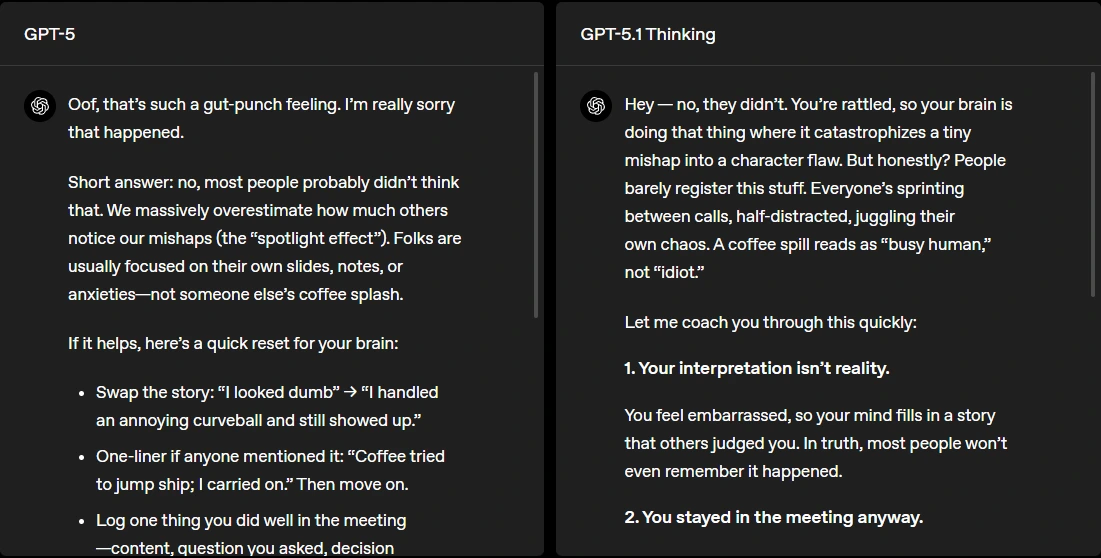
OpenAI provided side-by-side comparisons in their announcement, and the difference is striking. When a user mentioned feeling stressed, GPT-5 responded with a bulleted list of relaxation techniques—functional but clinical. GPT-5.1 Instant, on the other hand, opened with “I’ve got you, Ron — that’s totally normal, especially with everything you’ve got going on lately.”
That’s not just cosmetic. It’s a fundamental shift in how the model approaches human interaction. The old model optimized for completeness. The new one optimizes for connection.
2. Instruction Following That Actually Works
Anyone who’s used ChatGPT extensively knows the frustration of asking for something specific and getting… something adjacent. You’d ask for six words, and the model would give you six sentences with an apology attached.
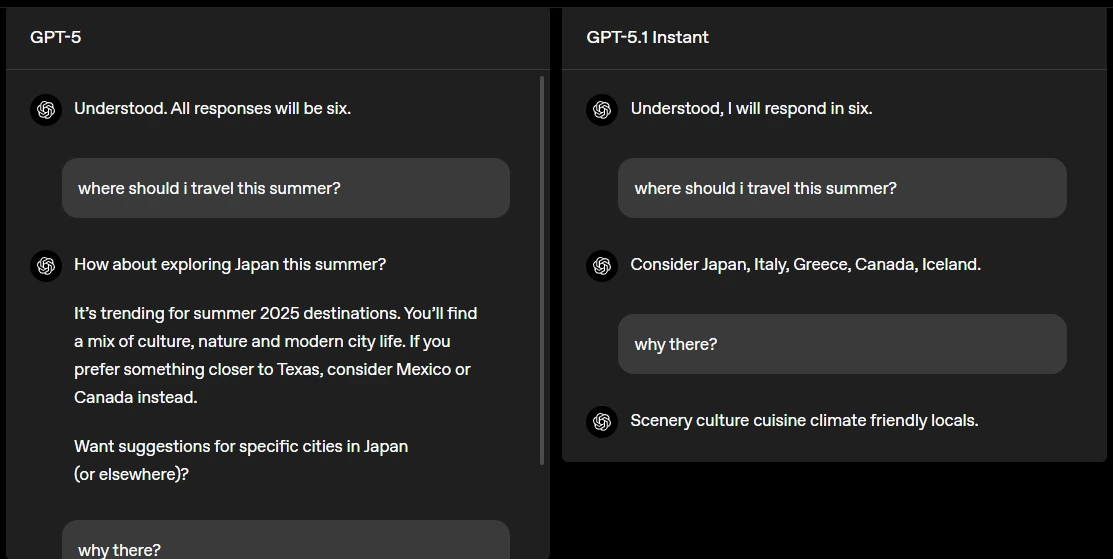
GPT-5.1 tightens this dramatically. In OpenAI’s own examples, when asked to “always respond with six words,” GPT-5 immediately broke its own rule. GPT-5.1 stuck to it consistently across multiple follow-ups.
This improvement extends beyond party tricks. For professionals using ChatGPT for structured workflows—research assistance, code generation, content creation—this means fewer wasted iterations and more predictable outputs.
3. Adaptive Reasoning: Thinking When It Matters
Here’s where things get technically interesting. GPT-5.1 Instant now incorporates adaptive reasoning, which means it can internally decide when a problem warrants deeper analysis before responding.
This is reflected in measurable performance gains on benchmarks like AIME 2025 (a math competition) and Codeforces (a programming challenge platform). The model doesn’t just answer faster—it answers better on complex problems while still maintaining speed on simple queries.
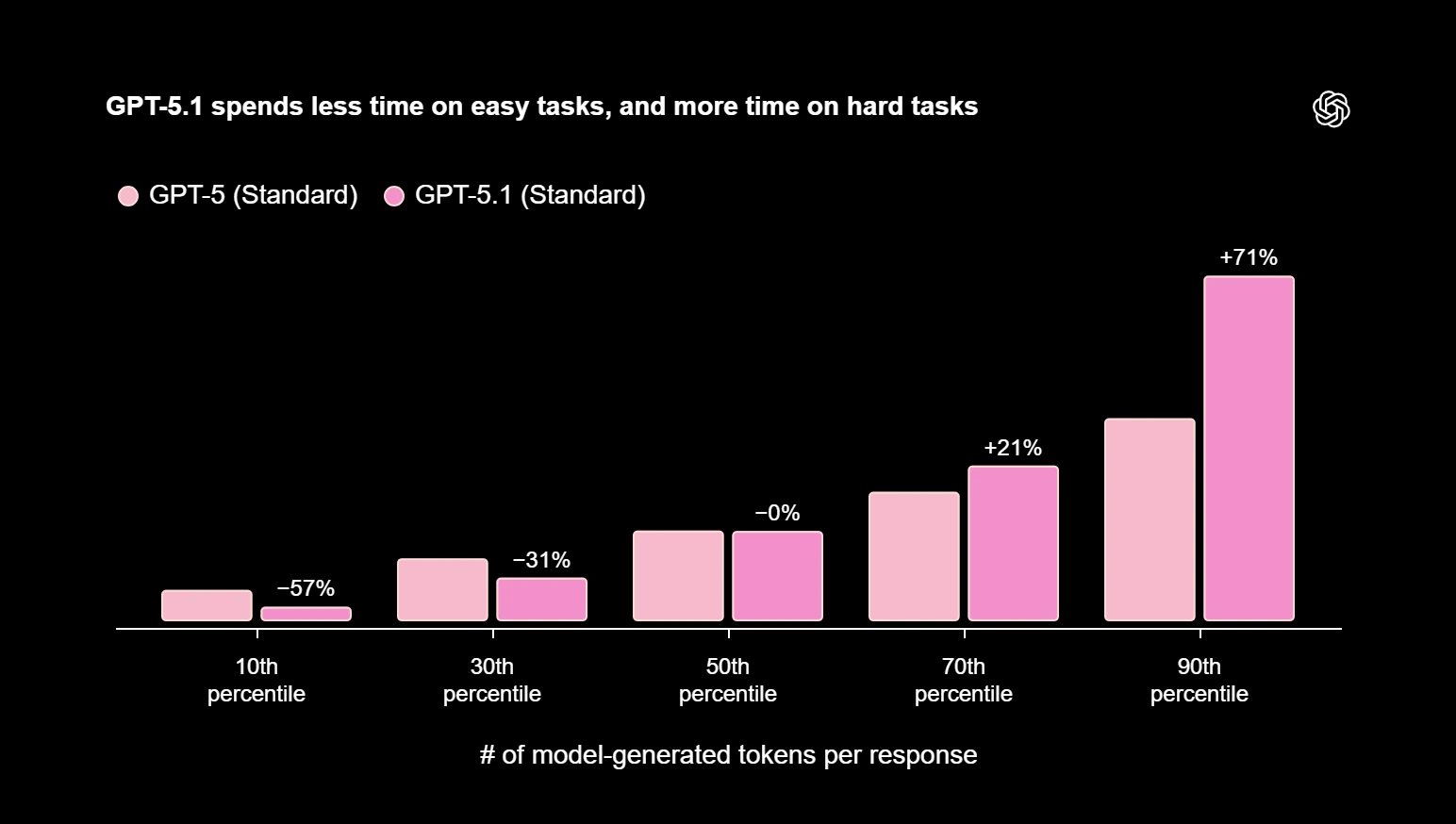
For GPT-5.1 Thinking, adaptive reasoning works differently. The model now dynamically adjusts its “thinking time” based on the complexity of the task. On representative ChatGPT tasks, GPT-5.1 Thinking is roughly twice as fast on simple problems and twice as slow on complex ones compared to GPT-5 Thinking.
Translation: You’re not waiting unnecessarily for easy answers, but the model takes its time when accuracy matters.
4. Clearer Explanations with Less Jargon
One of the most underrated improvements is how GPT-5.1 Thinking communicates complex information. The model now defaults to clearer language, fewer undefined terms, and a more empathetic tone.
In OpenAI’s baseball statistics example (explaining BABIP and wRC+), GPT-5 delivered a technically accurate but dense response filled with formulas and insider terminology. GPT-5.1 Thinking opened with “Nice, nerd stat time ????” and proceeded to break down the same concepts in plain English with relatable context.
This matters enormously for workplace use cases—explaining technical concepts to non-technical stakeholders, onboarding new team members, or creating documentation that people will actually read.
Customization: Making ChatGPT Sound Like You
Beyond model improvements, OpenAI introduced significantly expanded customization options. This is where GPT-5.1 starts feeling less like a tool and more like a personalized assistant.
Personality Presets
ChatGPT now offers six core personality modes:
- Default – Balanced, general-purpose tone
- Professional – Polished and precise for workplace communication
- Friendly – Warm and chatty (formerly “Listener”)
- Candid – Direct and encouraging
- Quirky – Playful and imaginative
- Efficient – Concise and plain (formerly “Robot”)
The original Cynical and Nerdy modes remain available for users who prefer those styles.
These aren’t superficial skin changes—they fundamentally alter how the model structures responses, chooses vocabulary, and balances detail versus brevity.
Granular Fine-Tuning (Experimental)
For users who want even more control, OpenAI is rolling out experimental sliders that let you adjust:
- Conciseness – How brief or detailed responses should be
- Warmth – Emotional tone and empathy level
- Scannability – Use of formatting, bullets, and structure
- Emoji frequency – How often (if ever) emojis appear
This is a game-changer for power users. If you’re using ChatGPT for client-facing communications, you might want high warmth and low emoji usage. For personal brainstorming, maybe you prefer quirky with high emoji frequency.
What’s particularly smart: ChatGPT can proactively suggest tone adjustments during conversations. If you repeatedly ask for more concise answers, the model will offer to update your preferences automatically.
Rollout and Availability
GPT-5.1 is rolling out gradually, starting with paid users (Plus, Pro, Go, Business) before expanding to free accounts. Enterprise and Education plans get a seven-day early-access toggle.
API Access is coming later this week:
- GPT-5.1 Instant →
gpt-5.1-chat-latest - GPT-5.1 Thinking →
gpt-5.1(with adaptive reasoning)
Legacy Support: GPT-5 models (Instant, Thinking, and Pro) will remain available in the legacy models dropdown for three months, giving users time to compare and transition smoothly.
This is a mature approach to model deprecation—something OpenAI learned the hard way after the GPT-5 backlash, when they initially planned to remove GPT-4o entirely before user outcry forced a reversal.
Real-World Performance: Who Benefits Most?
After reviewing the technical specs and user feedback, here’s who I think gains the most from GPT-5.1:
Content Creators and Writers
The warmer tone and better instruction following make GPT-5.1 significantly more useful for creative work. You’re not fighting the model to match your voice—you’re collaborating with it.
Developers and Engineers
Improved performance on coding benchmarks (Codeforces gains) and better adaptive reasoning mean fewer debugging sessions caused by misunderstood requirements. The model’s ability to think longer on complex logic problems is a legitimate productivity boost.
Business Professionals
The Professional tone preset alone makes ChatGPT more viable for client communications, reports, and presentations. Combine that with reduced jargon in technical explanations, and you’ve got a tool that can bridge technical and business teams more effectively.
Educators and Students
GPT-5.1 Thinking’s clearer explanations with less jargon make it better suited for learning environments. The model doesn’t just give you answers—it walks you through concepts in accessible language.
Casual Users
Honestly, if you’re just using ChatGPT for quick questions, recipe ideas, or occasional help, the warmer default tone makes the experience feel less mechanical. That matters more than you’d think for long-term adoption.
What Could Be Better?
No tool is perfect, and GPT-5.1 has areas where I’d like to see improvement:
Limited Message Caps on Free Tier
Free users get 10 messages with GPT-5.1 every 5 hours before being downgraded to the mini model. For casual use, that’s fine. But if you’re seriously testing whether to upgrade to Plus, that’s a frustratingly short trial period.
Customization Complexity
While the granular tuning options are powerful, they add cognitive overhead. Not everyone wants to think about “scannability sliders.” OpenAI would benefit from smart defaults that learn from your usage patterns rather than requiring upfront configuration.
API Naming Confusion
Calling the Instant model gpt-5.1-chat-latest while the Thinking model is just gpt-5.1 feels inconsistent. For developers managing multiple model versions, this naming scheme could cause headaches.
Unclear Performance Benchmarks
OpenAI provided examples and anecdotal improvements but didn’t release comprehensive benchmark data comparing GPT-5.1 to GPT-5 across diverse task types. More transparency here would help enterprise customers justify upgrades.
The Bigger Picture: What GPT-5.1 Signals
This release tells me three things about OpenAI’s strategic direction:
1. User Experience Matters as Much as Raw Capability
The entire GPT-5.1 announcement emphasizes feel, tone, and customization over pure performance gains. OpenAI is acknowledging that AI adoption isn’t just about intelligence—it’s about whether people enjoy using the tool.
2. Personalization Is the Next Frontier
The extensive customization options signal OpenAI’s belief that one-size-fits-all AI is dead. The future is models that adapt to individual preferences, professional contexts, and conversational styles.
3. Iterative Updates Are Here to Stay
By naming this GPT-5.1 instead of GPT-6, OpenAI is setting expectations for continuous, meaningful improvements within model families. This is smarter product management—avoiding the hype cycle of major version numbers while still delivering value.
Final Verdict: Is GPT-5.1 Worth It?
For paid users: Absolutely. The improvements to instruction following alone justify the upgrade, and the warmer conversational tone makes daily use more pleasant. If you use ChatGPT professionally, the new customization options are game-changing.
For free users: You’ll get access eventually, but the 10-message cap means you’ll mostly be using the mini model. If you find yourself hitting that limit regularly, it’s a clear signal to upgrade to Plus.
For API users: The adaptive reasoning improvements and better instruction following should reduce token waste and improve output quality. Worth testing in production, but monitor costs carefully as adaptive reasoning may increase token usage on complex queries.
For businesses: The Professional tone preset and reduced jargon in technical explanations make GPT-5.1 significantly more viable for customer-facing applications. The three-month legacy window gives you time to test thoroughly before committing.
Bottom Line
GPT-5.1 isn’t revolutionary—it’s evolutionary in the best possible way. OpenAI took a step back, listened to user feedback, and refined the experience where it mattered most. The result is an AI that’s not just smarter, but more human in its interactions.
After 15 years of reviewing digital products, I’ve learned that the best tools aren’t the ones with the most features—they’re the ones you actually want to use. GPT-5.1 crosses that threshold in a way GPT-5 didn’t quite manage.
If you’re already using ChatGPT, you should upgrade. If you’ve been on the fence about trying it, this is the version to start with.
For more insights on how GPT-5.1 compares to other AI models, check out our detailed comparison between ChatGPT Atlas vs Perplexity Comet, and read our ChatGPT Atlas review 30 days later for long-term performance insights.
Have you tried GPT-5.1 yet? I’m curious how the new tone options and adaptive reasoning are working in real-world workflows. The Professional mode alone could be a game-changer for client communications—but I want to hear if the hype matches reality.
Frequently Asked Questions
What’s the main difference between GPT-5.1 Instant and GPT-5.1 Thinking?
GPT-5.1 Instant is optimized for speed and everyday tasks with improved conversational quality, while GPT-5.1 Thinking is designed for complex reasoning problems where accuracy matters more than response time. Thinking mode uses adaptive reasoning to spend more time on difficult problems and less on simple ones.
How many messages can free users send with GPT-5.1?
Free users get 10 messages with GPT-5.1 every 5 hours before being downgraded to the mini model. This allows casual testing but may be limiting for users who want to fully evaluate the model’s capabilities.
Can I still use GPT-5 after GPT-5.1 is released?
Yes, all GPT-5 models (Instant, Thinking, and Pro) will remain available in the legacy models dropdown for three months, giving users time to compare performance and transition smoothly to GPT-5.1.
What personality modes are available in GPT-5.1?
GPT-5.1 offers six core personality modes: Default (balanced), Professional (polished), Friendly (warm), Candid (direct), Quirky (playful), and Efficient (concise). The original Cynical and Nerdy modes are also still available for users who prefer those styles.
Is GPT-5.1 worth upgrading to for business use?
Yes, particularly for customer-facing applications. The Professional tone preset, improved instruction following, and reduced jargon in technical explanations make GPT-5.1 significantly more viable for client communications, reports, and bridging technical and business teams effectively.

AI tools expert with over 10 years of experience testing and reviewing technology products.